
By switching to the income method to determine property tax assessments for billboards, the City of Milwaukee is expected to raise an additional $1.2 million in revenue from the two largest billboard operators in the city, according to the Milwaukee Business Journal.
Clear Channel, which has over 800 billboards in the city, is likely to see its tax bill jump from just over $100,000 last year to over $1.1 million this year under the new method. Lamar Advertising's bill would increase from $82,000 to $320,000- a nearly 300% increase.
Clear Channel has filed suit to challenge Milwaukee's new assessment method, but the city believes a recent Wisconsin Supreme Court decision involving a similar case in the city of Madison gives the city an ample basis to use the income approach.
Expect more cities to follow the lead of Milwaukee by seeking increased revenues from an industry that would not exist without public investment in roads.
Friday, November 27, 2009


Saturday, November 21, 2009
Cleveland Officials Call Foul on LeBron Mega-Billboard
 existing supergraphic allowed by city
 NBA superstar LeBron James generally rules Cleveland, but a shot by Nike to replace an existing mega-billboard of the hometown hero with a more blatant commerical ad was blocked by the City Planning Commission.
The existing sign does contain the Nike swoosh, but the city approved it on the basis that it is mural art. However, the proposed new sign was determined to be an advertisement for Nike and prohibitted by the city sign code.
Although advocates might question whether the current ten-story supergraphic with a world-famous corporate logo is art, city officials nevertheless should be applauded for blowing the whistle on this latest attempt to erect a blatant ten-story supergraphic ad.
Friday, November 20, 2009
LA Law

Last month, we brought you the news out of Los Angeles that a federal judge had issued a temporary order dismissing the challenge of LA's restrictions on digital billboards. We're happy to report that her final ruling reaffirmed this decision.
But that's not all. Earlier this month a Superior Court judge struck down a controversial settlement in 2006 between a prior city attorney and Big Billboard that allowed over 800 traditional billboards to be switched to digital technology. However, the judge tampered the jubilation of scenic advoactes as he declined to void the permits of the 101 digital signs that already have been erected under the settlement agreement; instead, a case by case review of each sign may be required.
So what does the future hold for these digital bad boys? If community advocates have any say, the digitals will come down. Earlier this week, dozens of concerned citizens turned out for a city hearing on a new proposal that would order the Department of Building and Safety to stop issuing any new digital permits and to evaluate whether existing permits should be revoked.
To follow the roller coaster of legal developments, visit Ban Billboard Blight.
Thursday, November 19, 2009
FHWA Awards Scenic Byways Communities $41 Million
Communities in 43 states received nearly $41 million from the Federal Highway Administration for 160 projects to improve and promote scenic byways. 
Scenic Byways grants fund a wide array of projects that enhance the byway experience for visitors.
Examples of projects that received funding for scenic preservation and enhancement include viewshed protection for North Carolina's Nantahala byway, the construction of a scenic landscape and wildlife observation deck for Wisconsin's Alma byway, a scenic pullout for South Carolina's Cherokee Foothills byway, and the development of a resource protection plan for Arizona's Navajo Nation byway.
Other grants helped support the development of marketing and interpretive materials, the construction of pedestrian and bicycle facilities, historic preservation projects, and safety improvements.
For the official FHWA press release and list of grants, click here. And don't forget to seek out America's Scenic Byways in your future travels!

Scenic Byways grants fund a wide array of projects that enhance the byway experience for visitors.
Examples of projects that received funding for scenic preservation and enhancement include viewshed protection for North Carolina's Nantahala byway, the construction of a scenic landscape and wildlife observation deck for Wisconsin's Alma byway, a scenic pullout for South Carolina's Cherokee Foothills byway, and the development of a resource protection plan for Arizona's Navajo Nation byway.
Other grants helped support the development of marketing and interpretive materials, the construction of pedestrian and bicycle facilities, historic preservation projects, and safety improvements.
For the official FHWA press release and list of grants, click here. And don't forget to seek out America's Scenic Byways in your future travels!
San Francisco Citizens Say No to Billboards
The heft of a powerful developer and the billboard industry was no match for the grass roots efforts of scenic advocates as San Francisco voters soundly rejected Proposition D, a ballot iniative that would have created an intensive billboard district in the heart of the city.
San Francisco Beautiful led the fight to defeat the effort to lift a ban on new billboards so that the historic Market Street Street could be blanketed with intensive digital billboard advertising. The defeat of the proposition reaffirmed the strong civic pride and sense of place that make San Francisco a world class city. San Francisco Beautiful President Milo Hanke remarked, "San Francisco voters removed all doubt - they will tolerate no new billboards."
San Francisco voters blocked previous measures that would allow new billboard measures in 2002 and 2007.
The defeat of Prop D was not the only good news for scenic advocates on election day: city voters also passed Proposition E, which prohibits additional advertising on city property.
San Francisco Beautiful led the fight to defeat the effort to lift a ban on new billboards so that the historic Market Street Street could be blanketed with intensive digital billboard advertising. The defeat of the proposition reaffirmed the strong civic pride and sense of place that make San Francisco a world class city. San Francisco Beautiful President Milo Hanke remarked, "San Francisco voters removed all doubt - they will tolerate no new billboards."
San Francisco voters blocked previous measures that would allow new billboard measures in 2002 and 2007.
The defeat of Prop D was not the only good news for scenic advocates on election day: city voters also passed Proposition E, which prohibits additional advertising on city property.
Monday, October 19, 2009
U.S. Transportation Secretary Ray LaHood Announces America's Byways Designations for 2009
Scenic America has always maintained a close working relationship with the National Scenic Byways Program, and we're happy to announce that a new round of scenic byways designations have been granted.Click here to read the official release.
Wednesday, October 7, 2009
The Benefits of Context Sensitive Solutions
The Transportation Research Board has released the important new report "Quantifying the Benefits of Context Sensitive Solutions."
Scenic America was an influential organization in establishing the CSS movement to have engineers and planners rethink design. By thinking beyond the pavement and an almost exclusive focus on design speed, CSS incorporates flexibility and greater stakeholder involvement in order to acheive designs that are in harmony with the aesthetic, community and natural environment.
Now that the movement has matured, research has been able to to confirm that utilizing CSS acheives better results and increased lasting value for communities. The TRB report presents helpful guidelines for agencies for quantifying the benefits of applying CSS to transportation projects and is helpful for community advocates.
Scenic America was an influential organization in establishing the CSS movement to have engineers and planners rethink design. By thinking beyond the pavement and an almost exclusive focus on design speed, CSS incorporates flexibility and greater stakeholder involvement in order to acheive designs that are in harmony with the aesthetic, community and natural environment.
Now that the movement has matured, research has been able to to confirm that utilizing CSS acheives better results and increased lasting value for communities. The TRB report presents helpful guidelines for agencies for quantifying the benefits of applying CSS to transportation projects and is helpful for community advocates.
Tuesday, October 6, 2009
Indiana OA Control "Out of Control"
The failure of the Indiana Department of Transportation (INDOT) to adequately control outdoor advertising and follow the Highway Beautification Act is risking the Hoosier state $90 million in federal highway funds, reports the Post-Tribune.
The problems found by the Federal Highway Administration include numerous billboards located in areas that are illegal under federal law, and dozens, if not not hundreds, that appear to have been erected without a permit of any kind at all.
State officials believe that it may cost as much as $2.5 million to establish a proper billboard inventory and sort through the problems with lax enforcement of the law. But as the article notes, at a paltry initial permit fee of just $100 for each billboard, the billboard industry itself isn't going to pay for sorting out the mess.
The problems found by the Federal Highway Administration include numerous billboards located in areas that are illegal under federal law, and dozens, if not not hundreds, that appear to have been erected without a permit of any kind at all.
State officials believe that it may cost as much as $2.5 million to establish a proper billboard inventory and sort through the problems with lax enforcement of the law. But as the article notes, at a paltry initial permit fee of just $100 for each billboard, the billboard industry itself isn't going to pay for sorting out the mess.
Wednesday, September 30, 2009
Digital Driver Distraction
Scenic America applauds the Distracted Driver Summit, convened by Transportation Secretary Ray LaHood, for its inclusion of the safety concerns of digital billboards.
Presenter Dr. John Lee of the University of Wisconsin noted that billboards can be a cause of motorist distraction outside of vehicles. Dr. Lee also remarked that while the issue of digital billboard distraction is an active topic of FHWA research, prior studies on the issue have found that they can be a source of distraction.
In fact, the recently completed review of prior studies conducted for AASHTO found:
Presenter Dr. John Lee of the University of Wisconsin noted that billboards can be a cause of motorist distraction outside of vehicles. Dr. Lee also remarked that while the issue of digital billboard distraction is an active topic of FHWA research, prior studies on the issue have found that they can be a source of distraction.
In fact, the recently completed review of prior studies conducted for AASHTO found:

"...of those research studies that have addressed driver distraction and roadside billboards, nearly every empirical study undertaken since 1995, including that by Lee et al., and sponsored by the outdoor advertising industry, have demonstrated that there is an adverse relationship between distraction and digital billboards."
The bottom line is that a growing and sound body of scientific evidence has confirmed the intuitive notion that digital billboards -- essentially giant televisions on a stick that change ad copy as much as every six seconds -- pose an unnecessary safety risk.
State and local government officials need to protect the public safety and either prohibit or strongly restrict digital signs.
Tuesday, September 29, 2009
Distracted Driving Summit webcast Wed & Thurs
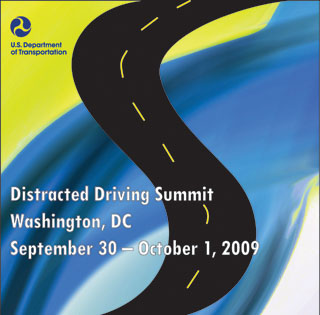 The DOT will be holding a summit on the problems of distracted driving in Washington DC on Wednesday and Thursday of this week. No word on whether billboards, and digital billboards in particular, are going to be part of the conversation. It's likely that cell phones (calling and texting) will be the primary topic of conversation, since they were the subject of a study released over the summer and it's gotten heavy play in the media.
If you'd like to watch part or all of the webcast, you can do so here.
Subscribe to:
Posts (Atom)